
Freelance Invoice & VAT Tracker
Made for freelancers and sole traders who invoice and are VAT registered.
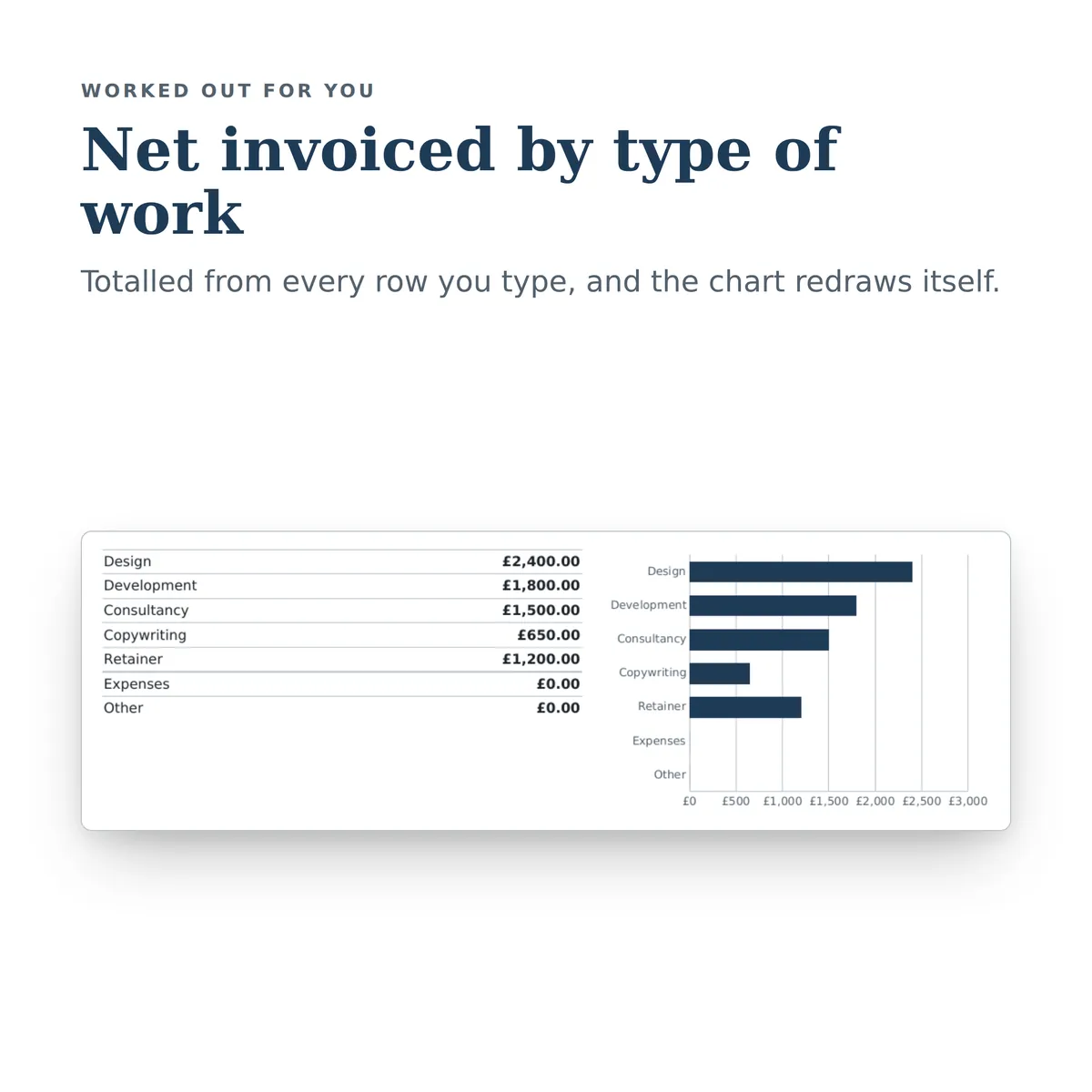
Tracks every invoice sent, what is outstanding, what is overdue, and how much VAT is due this quarter, with a reusable client list. The summary carries a chart that redraws itself as you type.
Of the 25 columns, you fill in 17 and the other 8 work themselves out, and all 14 figures on the summary do too. There is room for 460 rows of your own.
£4.99one payment, yours to keep
- Opens in Excel, Google Sheets and Numbers
- Delivered straight away
- No macros, nothing to install
- Change it free before you buy
Payment is handled by Stripe. Your card details go to them and never to us. Sales are final, which is why every tab, column and calculation is shown on this page first.
Already have a spreadsheet of your own? Check it for mistakes, free.
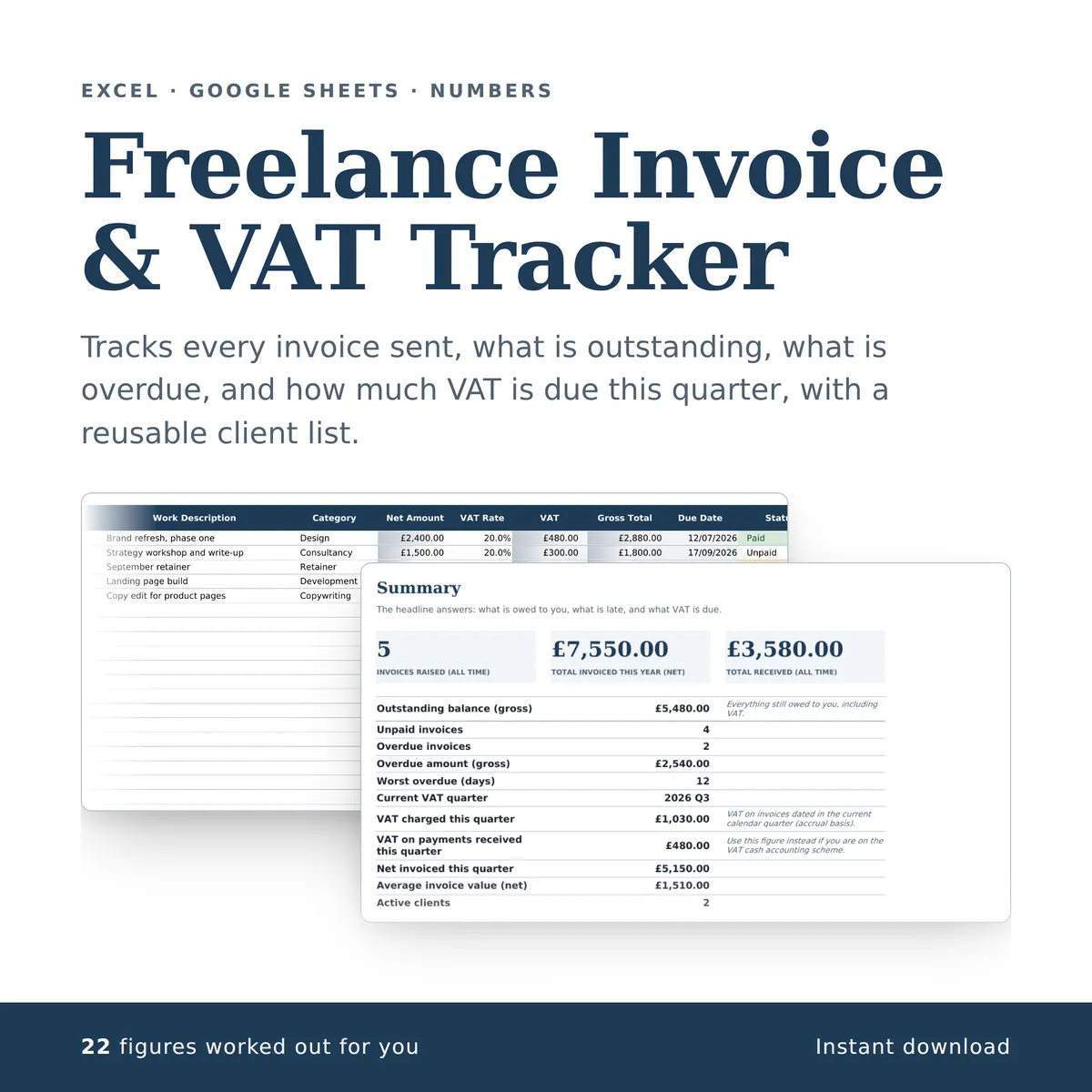
- A new row is typed into the Invoices tab, one cell at a time, in the white cells a person fills in.
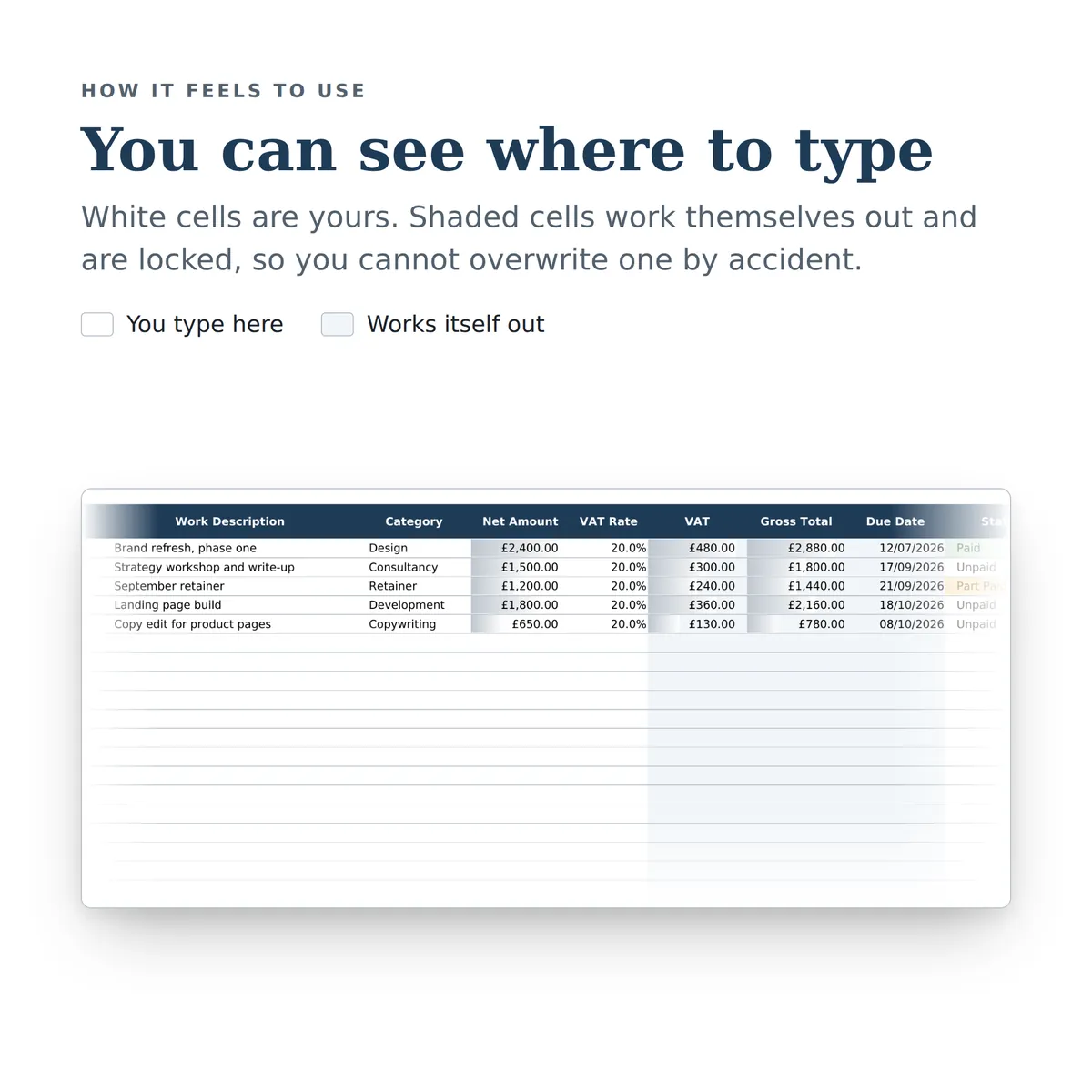
- The shaded cells in that row fill themselves in.
- The figures on the Summary tab change to include the new row.
- The chart, Net invoiced by type of work, redraws with it.
Everything inside, before you pay
This is the whole design: every tab, every column and how each calculated one is worked out. White cells are yours to fill in; the shaded ones work themselves out and are locked so a formula cannot be overwritten by accident. There is room for 460 rows. Open any tab to see its columns.
Clients
9 columns
| Column | What goes in it | Worked out as |
|---|---|---|
| Client | Use a short, consistent name: this is what you pick on the Invoices tab.Type any text. | |
| Contact | Type any text. | |
| Type any text. | ||
| Payment Terms (Days) | Days from invoice date until payment is due. Typically 14, 30 or 45.Type a number. | |
| Day Rate | Type an amount in £. | |
| Status | Pick one: Active, Occasional or Dormant. | |
| Total Invoiced (Net) | Fills itself in. | The total of Net Amount on Invoices where Client matches this row's Client. The formulaIF(ISBLANK([client_name]), "", SUMIF([Invoices!client], [client_name], [Invoices!net])) |
| Outstanding | Fills itself in. | Worked out from this row's Client, using Gross Total, Client and Status on Invoices. The formulaIF(ISBLANK([client_name]), "", SUMIFS([Invoices!gross_amount], [Invoices!client], [client_name], [Invoices!payment_status], "Unpaid") + SUMIFS([Invoices!gross_amount], [Invoices!client], [client_name], [Invoices!payment_status], "Part Paid")) |
| Notes | Type any text. |
Invoices
16 columns
| Column | What goes in it | Worked out as |
|---|---|---|
| Invoice No | Type any text. | |
| Invoice Date | Type a date. | |
| Client | Pick one of the Client entries on Clients. | |
| Work Description | Type any text. | |
| Category | Pick one: Design, Development, Consultancy, Copywriting, Retainer, Expenses or Other. | |
| Net Amount | Type an amount in £. | |
| VAT Rate | Usually 0.20. Use 0 for zero-rated or outside-scope work.Type a percentage, like 20%. | |
| VAT | Fills itself in. | The Net Amount times the VAT Rate. The formulaIF(ISBLANK([net]), "", ROUND([net] * [vat_rate], 2)) |
| Gross Total | Fills itself in. | Worked out from this row's Net Amount and VAT Rate. The formulaIF(ISBLANK([net]), "", ROUND([net] + [net] * [vat_rate], 2)) |
| Due Date | Invoice date plus the client's payment terms. Defaults to 30 days if the client is not listed.Fills itself in. | Worked out from this row's Invoice Date and Client, using Payment Terms (Days) and Client on Clients. The formulaIF(ISBLANK([invoice_date]), "", [invoice_date] + IFERROR(INDEX([Clients!payment_terms_days], MATCH([client], [Clients!client_name], 0)), 30)) |
| Status | Pick one: Unpaid, Part Paid, Paid or Written Off. | |
| Date Paid | Type a date. | |
| Amount Received | Type an amount in £. | |
| Balance Due | Fills itself in. | Worked out from this row's Net Amount, Status, VAT Rate and Amount Received. The formulaIF(ISBLANK([net]), "", IF([payment_status] = "Written Off", 0, ROUND([net] + [net] * [vat_rate] - IF(ISBLANK([amount_received]), 0, [amount_received]), 2))) |
| Days Overdue | Fills itself in. | Worked out from this row's Invoice Date, Status and Client, using Payment Terms (Days) and Client on Clients. The formulaIF(ISBLANK([invoice_date]), "", IF(OR([payment_status] = "Paid", [payment_status] = "Written Off"), 0, MAX(0, TODAY() - ([invoice_date] + IFERROR(INDEX([Clients!payment_terms_days], MATCH([client], [Clients!client_name], 0)), 30))))) |
| VAT Quarter | Calendar quarter the invoice falls in, e.g. 2026 Q3.Fills itself in. | Worked out from this row's Invoice Date. The formulaIF(ISBLANK([invoice_date]), "", YEAR([invoice_date]) & " Q" & ROUNDUP(MONTH([invoice_date]) / 3, 0)) |
Summary
14 figures
| Figure | Worked out as |
|---|---|
| Invoices raised (all time) | The number of rows on Invoices with Invoice No filled in. The formulaCOUNTA([Invoices!invoice_no]) |
| Total invoiced this year (net) | Worked out from VAT Quarter and Net Amount on Invoices. The formulaSUMIF([Invoices!quarter], YEAR(TODAY()) & " Q1", [Invoices!net]) + SUMIF([Invoices!quarter], YEAR(TODAY()) & " Q2", [Invoices!net]) + SUMIF([Invoices!quarter], YEAR(TODAY()) & " Q3", [Invoices!net]) + SUMIF([Invoices!quarter], YEAR(TODAY()) & " Q4", [Invoices!net]) |
| Total received (all time) | The total of Amount Received on Invoices. The formulaSUM([Invoices!amount_received]) |
| Outstanding balance (gross) | Everything still owed to you, including VAT. The total of Balance Due on Invoices. The formulaSUM([Invoices!balance_due]) |
| Unpaid invoices | Worked out from Status on Invoices. The formulaCOUNTIF([Invoices!payment_status], "Unpaid") + COUNTIF([Invoices!payment_status], "Part Paid") |
| Overdue invoices | The number of rows on Invoices where Days Overdue is above 0. The formulaCOUNTIF([Invoices!days_overdue], ">0") |
| Overdue amount (gross) | The total of Balance Due on Invoices where Days Overdue is above 0. The formulaSUMIF([Invoices!days_overdue], ">0", [Invoices!balance_due]) |
| Worst overdue (days) | The largest Days Overdue on Invoices. The formulaIFERROR(MAX([Invoices!days_overdue]), 0) |
| Current VAT quarter | Worked out from today's date. The formulaYEAR(TODAY()) & " Q" & ROUNDUP(MONTH(TODAY()) / 3, 0) |
| VAT charged this quarter | VAT on invoices dated in the current calendar quarter (accrual basis). Worked out from VAT Quarter and VAT on Invoices. The formulaSUMIF([Invoices!quarter], YEAR(TODAY()) & " Q" & ROUNDUP(MONTH(TODAY()) / 3, 0), [Invoices!vat_amount]) |
| VAT on payments received this quarter | Use this figure instead if you are on the VAT cash accounting scheme. Worked out from VAT, Date Paid and Status on Invoices. The formulaSUMIFS([Invoices!vat_amount], [Invoices!date_paid], ">=" & DATE(YEAR(TODAY()), (ROUNDUP(MONTH(TODAY()) / 3, 0) - 1) * 3 + 1, 1), [Invoices!date_paid], "<=" & TODAY(), [Invoices!payment_status], "Paid") |
| Net invoiced this quarter | Worked out from VAT Quarter and Net Amount on Invoices. The formulaSUMIF([Invoices!quarter], YEAR(TODAY()) & " Q" & ROUNDUP(MONTH(TODAY()) / 3, 0), [Invoices!net]) |
| Average invoice value (net) | Worked out from Net Amount on Invoices. The formulaIFERROR(SUM([Invoices!net]) / COUNT([Invoices!net]), 0) |
| Active clients | The number of rows on Clients where Status is “Active”. The formulaCOUNTIF([Clients!status], "Active") |
More in Business
-
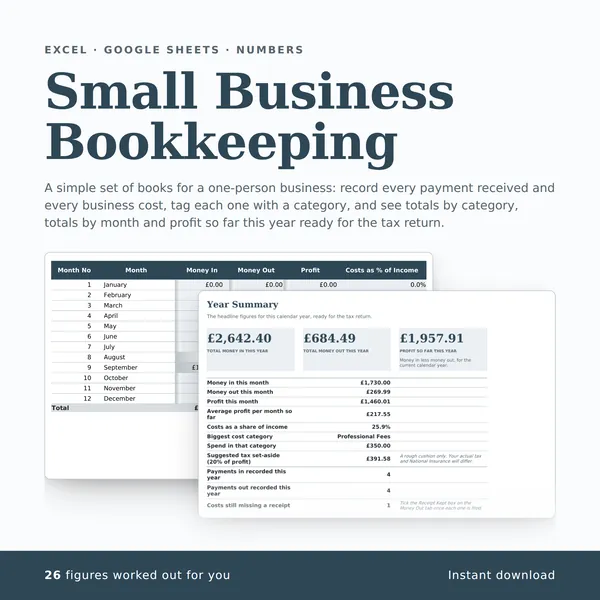
Small Business Bookkeeping
A simple set of books for a one-person business: record every payment received and every business cost, tag each one with a category, and see totals by category, totals by month and profit so far this year ready for the tax return.
26 figures work themselves out£4.99
-
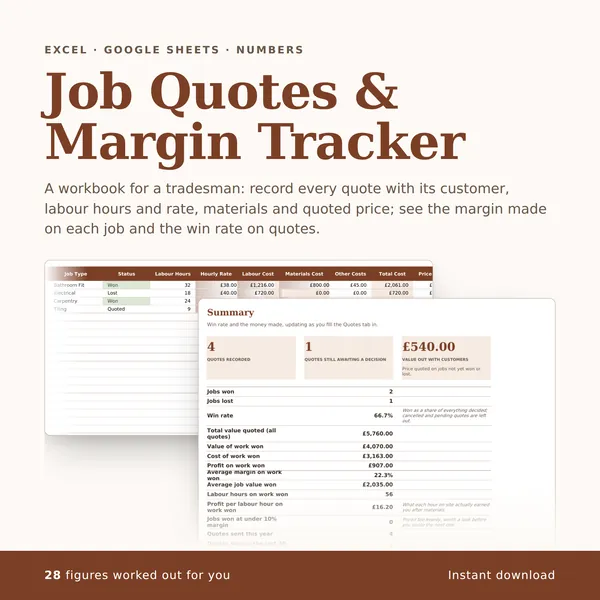
Job Quotes & Margin Tracker
A workbook for a tradesman: record every quote with its customer, labour hours and rate, materials and quoted price; see the margin made on each job and the win rate on quotes.
28 figures work themselves out£4.99
-

Etsy Seller Profit Tracker
Record every Etsy sale with fees, postage and materials, and see what each order and each item actually earns.
35 figures work themselves out£4.99
-

Client & Project Tracker
A workbook for tracking clients, the projects running for each one, what is due soon and the fees still to come in.
23 figures work themselves out£4.99